









By Dr Mia Steyn, MBChB, MRCP (Derm), Consultant Dermatologist at Dr Sam Bunting + Associates
Dr Mia Steyn is a Consultant Dermatologist at Dr Sam Bunting + Associates. She trained at the University of Stellenbosch and completed her post-graduate specialist dermatology training at the prestigious St John’s Institute of Dermatology in London, where she subsequently held a consultant role managing complex medical dermatology cases. She is on the GMC specialist register. Her clinical focus encompasses the full spectrum of dermatological conditions, from acne and rosacea to pigmentation, eczema, and hair loss, and she brings particular expertise to patients whose skin conditions have proved difficult to diagnose or manage elsewhere.
By now you've probably had microneedling recommended to you by at least three different sources: a friend, a facialist, an advert for a home roller that costs less than a facial. It gets talked about so widely that the meaning has blurred. Is it the same needle-covered roller you can buy online? Is it the same as Profhilo? Does it actually do anything?
I get versions of this question most weeks in the clinic, usually from patients looking at their pores, their acne scarring, or the early softening of their skin's texture, and wondering whether microneedling is the answer or a wasted afternoon. The honest answer depends entirely on what device is used, how deep it goes, and what you're actually trying to treat. Done properly, for the correct indication, it's an effective and well-evidenced tool. Done casually at home with a roller that barely reaches the surface, it does very little (at best).
Here's what microneedling actually is, how it works beneath the skin, and how to tell whether it belongs in your treatment plan. If you already know it's for you and want session details and pricing, our microneedling treatment page has that.
What Is Microneedling, and How Is It Different From an At-Home Derma Roller?
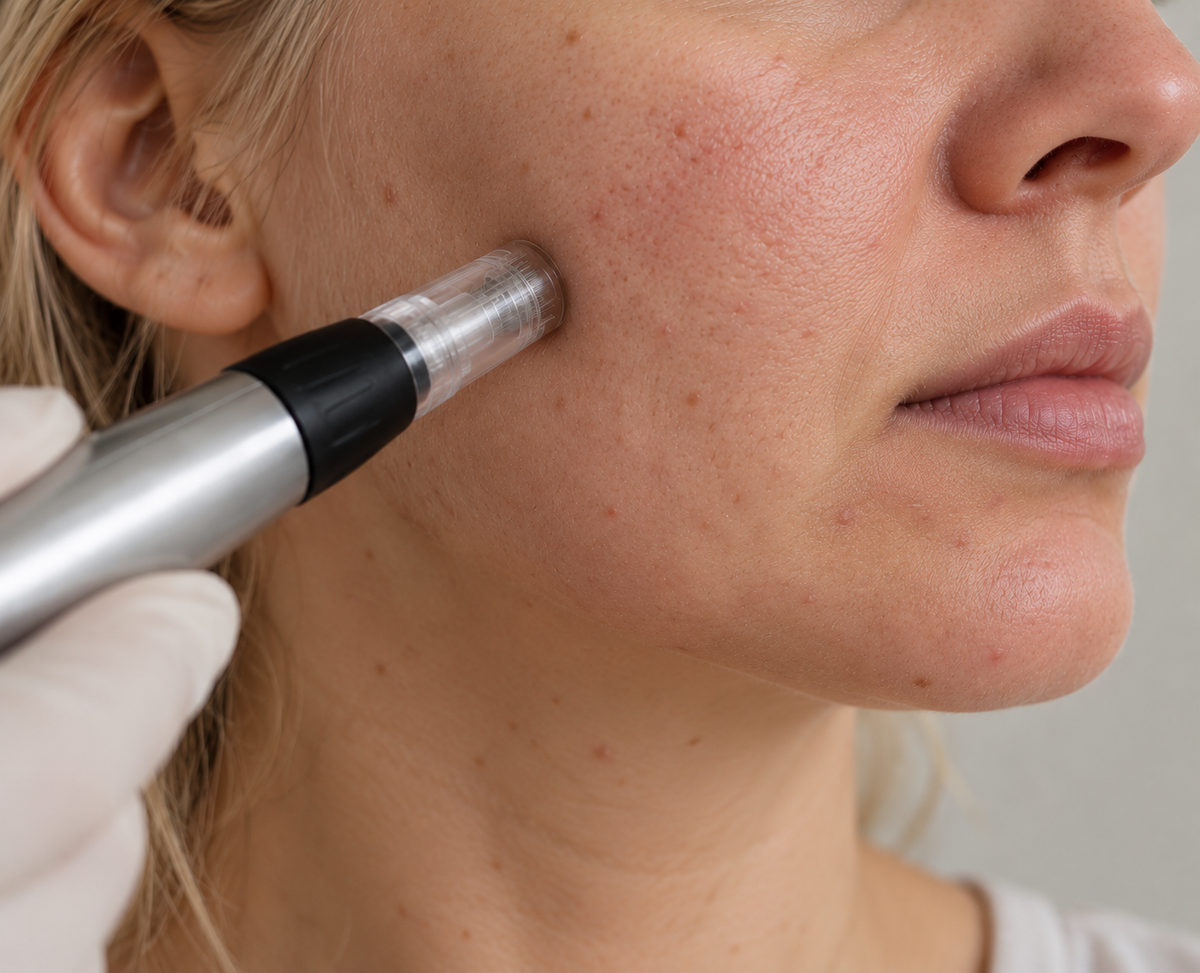
Microneedling, sometimes called collagen induction therapy, uses fine, sterile needles to create a controlled pattern of micro-injuries in the skin. Those tiny wounds sit in the dermis, the structural layer beneath the surface where collagen and elastin are made, and it's the skin's own repair response that drives the results, not the needles themselves. It is also important to note that I almost think of microneedling as a boot camp for your skin - it kickstarts repair processes. However, bootcamp is pointless without daily exercise - and if you know our clinic, you will already know what the daily exercise in this metaphor is: high quality, evidence-based daily skin care. You will get far more out of your microneeding if your skin is already primed for repair and rejuvenation by your tailored skin care plan.
This is where the at-home version and the in-clinic version part ways. A dermaroller you buy online typically has needles a fraction of a millimetre long, designed to stay superficial enough to use without supervision. In clinic, I use an automated device that can be adjusted to a precise depth of up to 2.5mm, depending on the area and what we're treating. That microinjury then stimulates new collagen, rather than just refreshing the surface. It's also why professional microneedling needs a trained clinician: knowing what you can and can’t treat with microneedling and choosing your technique accordingly are all important, and it's why we don't sell, stock, or recommend at-home devices at the clinic. The risk profile and the results simply aren't comparable.
How Does Microneedling Actually Work on the Skin?
Once the needles create those micro-channels, the skin responds the way it would to any small injury. It triggers a wound-healing cascade: growth factors are released, fibroblasts (the cells that manufacture collagen and elastin) are activated, and new blood vessels begin to form to support the repair. Over the following weeks, that translates into new collagen deposition and a gradual reorganisation of the collagen already there, which is what improves texture, firmness, and the visibility of scarring.
This is also why results build gradually rather than appearing overnight. The remodelling process continues for weeks after each session, and it's a process rather than a single event, which is something I set realistic expectations around before any patient starts a course.
Is Microneedling the Same as Profhilo or Polynucleotides?
No, and this is one of the most common mix-ups I clear up in consultations, because all three get marketed under the same broad banner of "skin rejuvenation" without doing the same thing. Profhilo works by delivering a slow-release form of hyaluronic acid into the skin, which hydrates the tissue and chemically signals fibroblasts to produce collagen.
Polynucleotides are also injected rather than needled across the skin, but the molecule itself, DNA-derived nucleotide chains rather than hyaluronic acid, works more on cellular repair and calming inflammation, which is why I reach for them most often around the delicate periorbital area.
Microneedling is different from both: it works mechanically. It's the physical micro-injury from the needles, not a substance, that triggers the skin's repair response. In practice, the three treat overlapping but different problems. Profhilo is my first choice for dehydration, early laxity, and skin that has simply lost its bounce, particularly on the neck. Polynucleotides are my first choice around the eyes, where the skin is too delicate and thin for needling at any real depth, and where their calming, reparative effect suits reactive or sensitive skin especially well. Microneedling is my first choice when there's structural change to correct, most often acne scarring, or when I want to improve how well other topical treatments penetrate alongside the mechanical stimulation. Some patients benefit from more than one of these, sequenced a few weeks apart, but I never default to combining them without a clear reason.
What Can Microneedling Treat?
In clinic, I use microneedling for:
- Atrophic acne scarring, and associated uneven skin texture, where the aim is to soften the depression rather than eliminate it entirely
- Fine lines and early loss of tone, often used as a maintenance treatment between more targeted procedures
- Mild skin laxity on the face and neck
- As a delivery method for other topical treatments, since the micro-channels temporarily improve how well serums penetrate
It is not the right tool for deep, tethered rolling scars that need subcision first, or for ice-pick scars, which respond far better to TCA CROSS. If your scarring needs that level of targeted correction, my colleague Dr Rakesh Patalay has written in detail about how we assess and sequence acne scar treatment, and microneedling often has a place later in that sequence rather than as the first step.
What Happens During a Microneedling Treatment?
Every session starts with a thorough cleanse and about 30 to 45 minutes with a topical numbing cream in place, which makes a meaningful difference to comfort once we begin. The device uses a set of fine, sterile needles that pulse rapidly to create the micro-channels, and the depth is adjusted according to what we're treating: shallower for general texture and tone, deeper for established scarring.
Most patients describe the sensation as a vibrating scratch rather than sharp pain, and the numbing cream takes the edge off almost entirely. Some pinpoint bleeding is normal, particularly at greater depths, and it settles quickly. Afterwards, your skin will look flushed, similar to a moderate bout of sunburn. Redness and mild swelling typically settle within 24 to 48 hours, though it can take a little longer, up to around five days, if we've treated more deeply. Makeup is best avoided until the following day, and we ask patients to keep sun exposure and strenuous exercise to a minimum for 24 hours afterwards.
How Many Sessions Will You Need?
A course of three sessions is what I recommend for most patients, spaced around four to six weeks apart to give the skin time to complete its remodelling between treatments. You'll usually notice early improvement within a few weeks of your first session, with the fuller effect building over two to three months as collagen continues to reorganise.
Results from a completed course tend to last six to twelve months, and most patients return for a single maintenance session within that window rather than repeating the full course. Scarring and more established texture changes sometimes need a longer initial course, which I confirm once I've properly assessed your skin.
As already mentioned, you will get more out of it if you also have a tailored skin care plan with well chosen actives to enhance and prolong the response.
Microneedling, Profhilo, Polynucleotides, and RF Microneedling: What's the Difference?
Microneedling itself has variants too, and radiofrequency (RF) microneedling is the one I'm asked about most. It combines the same needling mechanism with radiofrequency energy delivered through the needle tips, which adds a thermal injury to the mechanical one and produces more pronounced tightening. It generally needs fewer sessions than standard microneedling but comes with a higher cost and, in most cases, a little more downtime. It can be recommended for patients with more significant laxity than standard microneedling alone would meaningfully shift, however, if you reach this stage, laser might be a more beneficial treatment for you, in my opinion.
The table below sets all four options side by side.
| Treatment | What it's designed to do | Best suited to |
|---|---|---|
| Microneedling | Fine needles create controlled micro-injury, triggering mechanical collagen induction | Acne scarring, uneven texture, mild laxity |
| Profhilo | Delivers slow-release hyaluronic acid to hydrate and chemically stimulate collagen and elastin | Dehydration, crepiness, early laxity, dullness |
| Polynucleotides | Injects DNA-derived nucleotide chains to support cellular repair, calm inflammation, and rebalance pigment-producing cells | Reactive or sensitive skin, periorbital fine lines and crepiness, overall skin quality |
| RF Microneedling | Combines microneedling with radiofrequency energy delivered through the needle tips for a thermal effect | More significant laxity, deeper scarring, or where standard microneedling alone isn't enough |
Who Shouldn't Have Microneedling?
Microneedling isn't right for everyone, and part of every consultation is checking whether it's appropriate for you specifically. I'd want to know about, and in some cases postpone treatment for:
- Active acne or a current breakout, since needling through active inflammation risks spreading infection
- Blood clotting disorders or anticoagulant medication
- Current chemotherapy or radiotherapy
- A history of cold sores in the treatment area, or active eczema or psoriasis in that area
- A personal history of keloid or hypertrophic scarring
- Any mole, freckle, or skin lesion that has recently changed in size, shape, or colour; this needs assessment in its own right before anything else happens near it
- Pregnancy, where the safety data is limited enough that I generally recommend waiting
None of these are necessarily permanent exclusions. Some simply mean treating a different area, adjusting timing, or clearing an active flare first.
Signs Microneedling Might Be Right for You
As mentioned, this is best for patients who've already done the skincare work, and have a consistent routine with targeted actives and daily SPF, but still feel their skin isn't where they want it. If you can see or feel texture from old acne scarring that hasn't shifted despite good skincare, if your pores look more pronounced than they used to, or if your skin has started to look slightly duller and less even in tone without an obvious cause, these are the situations where microneedling is likely to help.
Frequently Asked Questions
Does microneedling hurt?
Most patients find it far more tolerable than they expect. We apply a topical numbing cream around 30 to 45 minutes before starting, which takes the edge off almost entirely for most areas. What you'll feel is more of a vibrating scratch than sharp pain, though areas over bone, such as the forehead or jawline, can feel slightly more noticeable. Deeper settings, used for established scarring, tend to be a little more sensitive than a general texture and tone treatment, but nothing that should put you off if you've been putting the appointment off out of worry.
Is microneedling safe for darker skin tones?
Yes, and this is one of its advantages over treatments that use heat, light, or laser energy. Because microneedling works mechanically rather than through a wavelength that background melanin can absorb, it carries a much lower risk of triggering post-inflammatory hyperpigmentation than laser resurfacing does. That makes it one of my preferred options for patients with Fitzpatrick skin types IV to VI who want to improve scarring or texture without that risk. I still take the same precautions with sun protection and post-care regardless of skin tone, because any inflammation, however triggered, carries some pigment risk.
Can I get the same results from an at-home derma roller?
Not to the same degree, and it's worth understanding why before you spend money on one. At-home rollers use much shorter needles, generally under half a millimetre, which means they can't reach the depth needed to meaningfully affect scar tissue or trigger significant collagen remodelling. Used without clinical training, they also carry a real risk of uneven pressure, poor sterilisation, and skin damage from repeated, unsupervised use. We don't sell, stock, or recommend at-home microneedling devices at the clinic for these reasons. If what you're addressing is genuine scarring or structural change, a professional course of treatment is the only route that will actually shift it.
Can microneedling be combined with other treatments?
Yes, and it often works best as part of a sequence rather than in isolation. For acne scarring, I frequently combine or alternate microneedling with treatments like TCA CROSS or laser, depending on the mix of scar types present, timed a few weeks apart so the skin can recover between sessions. It also pairs well with a consistent skincare routine, since a retinoid and daily SPF support and extend the collagen response between appointments. I map out the right sequence for each patient individually rather than offering a single default combination to everyone.
Ready to Find Out If Microneedling Is Right for You?
If what's bothering you is texture, not tone, scarring rather than a mark that will fade on its own, microneedling is very often the treatment that makes the difference, but only when it's matched properly to what your skin actually needs. At Dr Sam Bunting + Associates, every microneedling consultation starts with an honest assessment of your scarring or texture, not an assumption that this is the right procedure before we've looked. Current pricing is available on our Clinic Pricing page. To book a consultation, visit our Book an Appointment page, or email us at info@drsambunting.com with any questions first.