








Dr Rishika Sinha is a Consultant Dermatologist at Dr Sam Bunting + Associates, trained at the University of Cambridge and Member of the British Association of Dermatologist. She sees patients with hormonal acne and skin concerns every week in clinic and has a particular interest in the medical management of adult acne in women. She is on the GMC specialist register.
Spironolactone For Hormonal Acne: What It Is, Who It’s For, and What to Expect
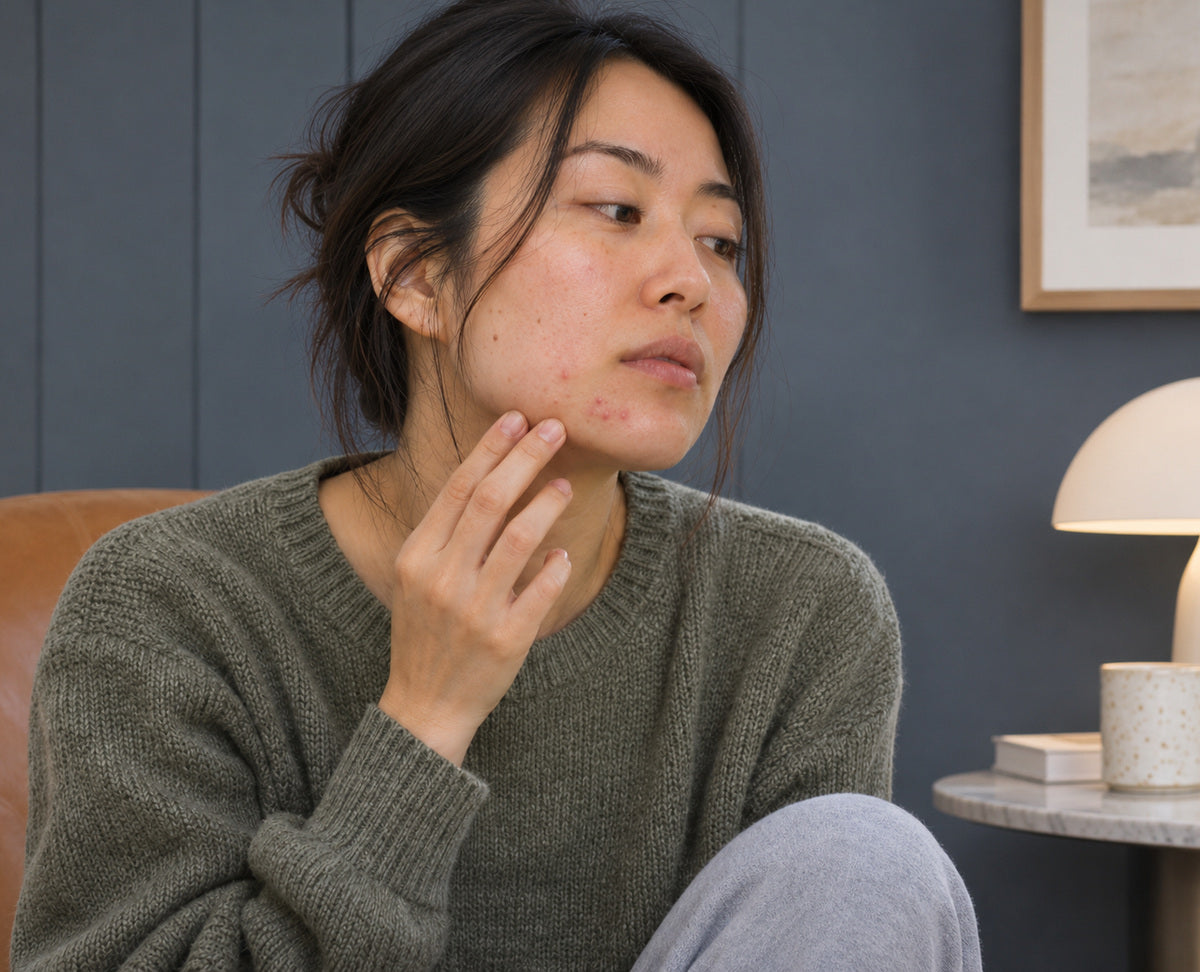
You’ve tried the routine. You’ve done the retinoid. You’ve completed a course of antibiotics, maybe two, and things improved while you were taking them, then came straight back. The breakouts are always in the same places, always on the lower face, and they reliably get worse before your period. You’ve probably started to suspect that something hormonal is going on, because nothing topical has ever truly resolved it.
You’d be right. And you may have come across spironolactone in your search for answers.
It’s a medication that generates a lot of online discussion and not much clarity. Someone swears by it, someone else says it disrupted their cycle, a third person says they were prescribed it without much explanation. I prescribe spironolactone regularly at Dr Sam Bunting + Associates. This blog is the clear, honest picture I give my patients before they start.
What Is Spironolactone And How Does It Work?
Spironolactone was originally developed as a blood pressure medication and diuretic. What became apparent over time is that it also blocks androgen receptors: the sites in the skin that respond to male hormones like testosterone and dihydrotestosterone (DHT). That anti-androgen property is what makes it useful for acne.
In women with hormonal acne, androgens overstimulate the sebaceous (oil) glands, producing excess sebum that blocks follicles and drives breakouts. Spironolactone doesn’t lower androgen levels in the blood. It blocks the receptor, so the androgen can’t trigger that sebaceous overactivity in the first place.
This distinction matters. It means spironolactone works at the point of action in the skin, rather than suppressing hormones throughout the body. That’s part of why its side effect profile is reasonable at the doses used in dermatology, and why it’s been used in women for this purpose for decades.
Is This Actually Hormonal Acne? How to Tell
Not all adult acne is hormonal, and spironolactone is only useful when it is. These are the patterns I look for in clinic.
The acne is predominantly on the lower face: jaw, chin, around the mouth, and sometimes the neck or upper chest. Acne driven by androgen excess tends to cluster in these areas because the sebaceous glands there are most sensitive to androgen stimulation.
It tracks with the menstrual cycle. The classic pattern is a flare in the week before a period, settling once menstruation begins. Some women notice a smaller flare around ovulation too.
It doesn’t fully respond to topicals, or it responds and relapses. If retinoids, azelaic acid, or benzoyl peroxide improve things but never clear them, or if antibiotics work only while you’re taking them, the issue is more likely systemic than surface-level.
The spots are deep and inflamed. Hormonal acne tends to produce cysts or nodules rather than surface congestion, and they often don’t come to a head in the way a typical whitehead does.
You may have other signs of androgen excess: oily skin that seems disproportionate, excess facial or body hair, or irregular periods.
Who Is Spironolactone For?
Spironolactone is used in women only. It is not appropriate for men because blocking androgen receptors produces feminising side effects that are not clinically acceptable in a male patient.
In women, it’s most useful when the acne pattern fits the hormonal picture above and hasn’t been adequately controlled by topical treatment or antibiotics. It is prescription-only and requires a proper clinical assessment before it’s issued, not because it’s particularly dangerous, but because the dose needs to be right, baseline bloods are needed in some patients, and contraception needs to be in place.
You do not need a raised androgen level on a blood test to be a candidate. Many women with clearly hormonal acne have androgen levels that sit within the normal laboratory range. What matters is the pattern and the clinical history, not a single number.
What About the Combined Oral Contraceptive Pill?
Many women with hormonal acne have already been prescribed the pill, sometimes specifically for their skin, and it’s worth understanding how it differs from spironolactone.
The combined oral contraceptive (COC) pill suppresses ovarian androgen production and raises levels of sex hormone binding globulin (SHBG), which mops up free testosterone in the circulation. For some women this is enough to control acne. For others it isn’t, either because their skin sensitivity at the receptor level remains high, or because the particular pill they’re on contains a progestogen with androgenic activity that partially counteracts the benefit.
Spironolactone and the pill work through different mechanisms. They are not interchangeable, and some women benefit from both. The right approach depends on your contraceptive needs, your medical history, and your response to previous treatments.
Spironolactone vs The Pill For Hormonal Acne: Key Differences
| Feature | Spironolactone | Combined Oral Contraceptive |
|---|---|---|
| How it works | Blocks androgen receptors at the sebaceous gland | Suppresses ovarian androgen production, raises SHBG |
| Contraceptive effect | None (requires separate contraception) | Yes |
| Dose flexibility | Yes, titrated from low to effective dose | Fixed dose per pill |
| Suitable if trying to conceive | No | No |
| Main side effects | Menstrual irregularity, diuretic effect, breast tenderness | Nausea, mood changes, VTE risk (small but real) |
| Onset for acne | 3–6 months | 3–6 months |
What Are the Side Effects?
At the doses used in dermatology, typically 25–150mg daily titrated up slowly, spironolactone is generally well tolerated. The side effects worth knowing about are:
Menstrual irregularity. The most commonly reported side effect at higher doses. Periods may become irregular or lighter. For some women this settles after a few months; for others it persists. If regular cycles matter to you, or you’re monitoring your cycle for any reason, this is worth discussing before you start.
Diuretic effect. Spironolactone increases urine output. At low doses this usually goes unnoticed. At higher doses some women notice increased thirst or more frequent urination in the first few weeks. Potassium levels can rise (hyperkalaemia), which is why we check renal function and electrolytes before starting and at intervals in appropriate patients.
Breast tenderness. Some women notice this in the early weeks. It usually settles as the body adjusts.
Postural dizziness. Occasionally, you’ll find that you are dizzy on standing up from sitting, particularly in women who already have low blood pressure. It’s usually mild and short-lived.
What spironolactone does not do, at dermatological doses, is cause significant hormonal disruption beyond what’s described above. It is not associated with weight gain, notable libido changes, or the mood effects some women experience with hormonal contraception.
What Spironolactone Cannot Be Taken During
Spironolactone is teratogenic: it carries a risk of feminising a male fetus if taken during pregnancy. Effective contraception is required for any woman of childbearing age taking it. If you are planning a pregnancy or think you might be pregnant, it must be stopped. This is a conversation I have at every first consultation before a prescription is issued, not as a footnote but as a non-negotiable part of the discussion.
What Results Can You Expect, And When?
Spironolactone is not a quick fix. It works by blocking androgen receptor activity at the sebaceous gland, and that takes time to translate into visible change at the skin surface.
Most women notice meaningful improvement between three and six months. Some see earlier change; others take longer. Doses may need to be adjusted throughout the course of treatment. When spironolactone works well for hormonal acne, it tends to work substantially. Not a modest improvement, but real, lasting clearing that topicals alone couldn’t achieve.
The benefit persists only with continued use. Stopping means androgen receptor activity returns, and acne typically resumes over the following months. For most women this makes spironolactone a long-term maintenance medication rather than a fixed course. That’s a conversation worth having at the outset, because starting is a commitment to ongoing use.
Can Spironolactone Be Used Alongside Skincare?
Yes, and I’d encourage it. Spironolactone addresses the hormonal driver of acne, but a consistent skincare routine manages the skin barrier, reduces surface congestion, and supports the overall result.
Ingredients like azelaic acid, niacinamide, and a non-comedogenic SPF all work alongside spironolactone rather than against it. If you’re also using a topical retinoid, it’s worth knowing that both can cause some initial skin adjustment in the first few weeks, so managing expectations at the start is helpful.
The two approaches are complementary. Getting the skincare right doesn’t make spironolactone redundant, and taking spironolactone doesn’t mean you can skip the routine.
Does Spironolactone Work for Hair Loss Too?
Yes, through the same mechanism. In women with androgenetic alopecia (female pattern hair loss), DHT causes progressive miniaturisation of hair follicles. Spironolactone blocks DHT at the follicle level, slowing or halting that process. It’s often used alongside minoxidil rather than as a standalone treatment, and it’s particularly useful in women who have both hair thinning and signs of androgen excess.
Hair loss is a different clinical picture to acne and warrants its own assessment. If thinning is also a concern for you, read our full guide to hair loss diagnosis and treatment, which covers how we diagnose different types of hair loss and the full range of prescription options available at the clinic.
Signs Spironolactone Might Be Worth Discussing
- Your acne clusters on the jaw, chin, or lower cheeks and has never fully cleared with topicals alone.
- Your skin breaks out reliably in the week before your period and settles once it starts.
- You’ve completed one or more courses of antibiotics that worked while you were taking them, then stopped working once you finished.
- You’re already on the Pill for your skin and still breaking out, and no one has explained why or suggested what else might help.
- Your acne is producing deep, inflamed spots or cysts that rarely come to a head cleanly.
Frequently Asked Questions
Do I need a raised androgen level on a blood test to be prescribed spironolactone?
No. Many women with clearly hormonal acne have androgen levels within the normal laboratory range. The pattern matters more than the number: where the acne is, whether it’s cyclical, and how it’s responded to previous treatments. Blood tests are still part of the process, both to check baseline renal function and electrolytes before starting, and to rule out conditions like polycystic ovary syndrome (PCOS) or late-onset congenital adrenal hyperplasia that might change the management approach.
Can I take spironolactone if I’m already on the contraceptive pill?
Yes, in many cases. Some women take both. The Pill and spironolactone work through different mechanisms, and combining them can be appropriate depending on your clinical picture and contraceptive needs. What isn’t appropriate is taking spironolactone without contraception if you’re of childbearing age, because of the risk to a male fetus in pregnancy. A consultation will work through what the right combination looks like for you specifically.
How long will I need to stay on spironolactone?
For most women, it’s a long-term maintenance medication. Acne driven by androgen receptor sensitivity doesn’t resolve permanently. It returns when the medication is stopped. Some women take it for years with consistent effect and no dose changes. Others, particularly those who reach the menopause, find the hormonal driver naturally diminishes and the dose can be slowly reduced. The timeline is individual and reviewed at each follow-up.
What happens to my acne if I want to get pregnant?
Spironolactone needs to be stopped before trying to conceive. How far in advance, and what to use in the interim, is something we plan proactively at the clinic. For most women with hormonal acne, we’d agree to a topical maintenance plan to manage the skin during the interval. It’s not an afterthought; it’s part of the ongoing management conversation.
When To See A Dermatologist
If your acne keeps returning to the same places, tracks with your cycle, and has never been fully controlled by topicals or antibiotics, it’s worth a proper clinical assessment. The pattern you’re describing is recognisable, it has a name, and there’s a treatment pathway for it.
A prescription for spironolactone shouldn’t be issued without a thorough history, a review of what you’ve already tried, and appropriate baseline checks. What a consultation gives you is clarity: not just whether spironolactone is right for you, but at what dose, alongside what else, and what to expect at every stage.
At Dr Sam Bunting + Associates, we see hormonal acne regularly and take a considered, unhurried approach to treatment. To book an assessment with our team, contact us at info@drsambunting.com or visit our Book an Appointment page.


