Which is the right retinoid for me? Retinol, retinaldehyde or HPR?
One of the most common questions I get asked is about retinoids - which one is the right one for me? The collective noun “retinoid” refers to the family of ingredients derived from vitamin A and includes retinyl palmitate, retinol, retinaldehyde, and hydroxypinacolone retinoate (HPR). I’d like to make an important note here - perhaps a touch pedantic! - there is no such thing as “retinols”, a term that’s frequently misused. There are retinoids, of which retinol is one type. These are commonly used in skincare products to improve the appearance of fine lines, wrinkles, and uneven skin tone. However, not all retinoids are created equal, and it's important to understand the differences between them in order to choose the one that offers the most benefit for your skin.
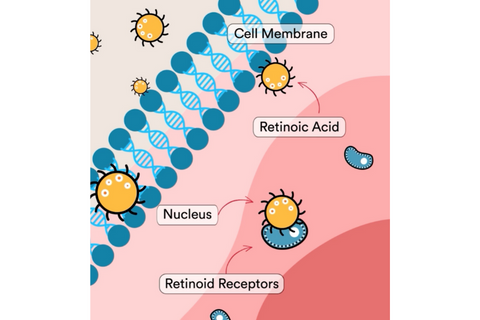
Retinoids as a group work by increasing cell turnover and stimulating collagen production, leading to a smoother, more youthful appearance. However, the efficacy of a retinoid can depend on its ability to convert to all-trans retinoic acid, the active form of vitamin A. I don’t include retinyl palmitate in this discussion because almost none makes it passed the skin barrier - you can do better! The key chemistry to be aware of is that both retinol and retinaldehyde *must* go through a series of oxidation steps before they can convert to all-trans retinoic acid, which is the form of vitamin A that can interact with specialised retinoid receptors. This has the effect of triggering increased or altered gene transcription inside the cell’s nucleus. Remarkably, more than 3000 genes are potentially influenced by retinoid binding to receptor. Within the cosmetic retinoid receptor space, HPR is the exception in that it’s already in its active form and can bind directly to retinoid receptors without the need for oxidation.
HPR vs Retinaldehyde: Which Retinoid Actually Delivers?
Retinaldehyde has earned a reputation as the most powerful over-the-counter retinoid you can buy. The logic is straightforward: it sits just one enzymatic step away from retinoic acid, the prescription-strength molecule that decades of dermatological research has proven to reverse photoageing. Closer to the gold standard means more potent. Simple.
Except skin biochemistry is rarely simple. And when you look more closely at what actually happens once a retinoid meets your skin, the picture gets more interesting.
The retinoid family tree
All topical retinoids are derivatives of vitamin A. They exist on a spectrum, and each one relates differently to retinoic acid, the form your skin cells can actually use.
The traditional hierarchy looks something like this. Retinyl palmitate and retinyl acetate are the gentlest and least potent. They require multiple conversion steps before the skin can use them. Retinol is one step up, requiring two conversions. Retinaldehyde (often shortened to “retinal”) requires just one. And at the top sits retinoic acid itself, available only on prescription because of its potency and its side effect profile.
Hydroxypinacolone retinoate (HPR) doesn’t sit neatly on this ladder, and that’s precisely what makes it worth understanding.
Where HPR breaks the hierarchy
HPR is a retinoic acid ester. In chemical terms, it’s directly related to retinoic acid rather than being a precursor that needs to be converted into it. This distinction matters more than it might initially sound.
When you apply retinol to your skin, it must be oxidised first to retinaldehyde, then again to retinoic acid, before it can bind to the retinoid receptors (known as RARs and RXRs) inside your skin cells. Retinaldehyde skips the first step but still requires that final conversion by the enzyme retinal dehydrogenase.
HPR doesn’t require either step. It binds directly to retinoid receptors in the cell nucleus. Research has confirmed this activity at three points in the biological pathway: at the receptor docking stage, at the level of retinoic acid response element (RARE) activation, and at the level of downstream gene expression.
This is a meaningful difference. Enzymatic conversion is not a guaranteed process. It’s influenced by factors including enzyme availability, skin condition, and individual variation. Two people applying the same retinaldehyde product may generate very different amounts of retinoic acid in their skin. With HPR, that variable is removed. The molecule arrives ready to work.
The stability question
There’s a second issue with retinaldehyde that gets far less attention than potency: stability.
Retinaldehyde is notoriously difficult to stabilise in a cosmetic formulation. The aldehyde group that makes it chemically reactive also makes it vulnerable to oxidation and degradation. This means the retinaldehyde concentration listed on the label may not reflect what’s biologically active by the time the product reaches your skin, particularly if it’s been exposed to air, light, or temperature fluctuation over weeks of use.
HPR has an inherently more robust stability profile. Its ester bond provides greater resistance to oxidative degradation, and it does not require the same level of protective formulation engineering to remain active over the shelf life of a product. In accelerated stability testing, HPR has been shown to maintain consistent biological activity under conditions where other retinoid forms degrade significantly.
This isn’t a minor technical detail. If a retinoid has degraded before it reaches your skin, its theoretical potency is irrelevant. Both retinol and retinaldehyde can be protected through a process called encapsulation, which helps shield them from degradation — but this adds formulation complexity and cost, making products more expensive without necessarily improving their performance over HPR.
What the research shows
The question that matters most is: what happens when these molecules meet real human skin?
Ex vivo studies using human skin explants (tissue samples that preserve the full structure of living skin) have compared HPR and retinaldehyde head to head across several endpoints relevant to anti-ageing.
Pro-collagen I production
Collagen I is the most abundant collagen in skin and the primary structural protein responsible for firmness. Under UV stress, collagen synthesis drops. When skin explants were treated with HPR and retinaldehyde at equivalent concentrations, both stimulated collagen recovery. HPR at half the concentration of retinaldehyde produced a greater uplift in pro-collagen I levels. This suggests HPR may be more efficient at driving collagen synthesis per unit of active delivered.
Epidermal thickness
UV exposure thins the epidermis, weakening the skin’s protective barrier. Both HPR and retinaldehyde helped preserve epidermal thickness under UVA stress compared to untreated controls. Both showed measurable protective benefit, confirming that the retinoid activity of each molecule translates into structural outcomes in the skin.
Keratin 14 expression
Keratin 14 is a protein produced by basal keratinocytes, the proliferative cells at the foundation of the epidermis. Its expression is a marker of healthy epidermal renewal. HPR produced a statistically significant increase in K14 expression compared to untreated skin, and showed the strongest improvement of the retinoids tested. This matters because it demonstrates that HPR drives skin renewal from the basal layer, the deepest part of the epidermis, rather than relying on surface-level exfoliation.
Irritation
In occlusive patch testing, HPR demonstrated a significantly lower irritation profile compared to retinol at equivalent concentrations. Retinaldehyde, while often better tolerated than retinol, still carries a higher irritation risk than HPR. This is consistent with HPR’s mechanism: because it doesn’t rely on conversion to retinoic acid (a process that can generate irritating intermediary metabolites), it produces a more targeted biological response with less collateral inflammation.
So is retinaldehyde a bad ingredient?
No. Retinaldehyde is a well-studied, effective retinoid with genuine clinical evidence behind it. It’s a legitimate choice, and for some formulations and skin types it works well.
The question isn’t whether retinaldehyde works. It’s whether it’s the most efficient way to get a retinoid response in your skin. When you account for conversion dependency, stability limitations, and the head-to-head performance data, HPR offers a more direct route to the same biological endpoints, with less irritation and less variability between users.
The idea that proximity to retinoic acid on a conversion chart equals real-world potency is an oversimplification. What matters is receptor activation, and for that, a molecule that arrives ready to bind will always have an advantage over one that needs your skin’s enzymes to finish the job.
One more thing worth knowing
HPR also pairs exceptionally well with other actives. Because it doesn’t generate the same degree of free radical activity or inflammatory signalling during its metabolism, it can be combined with ingredients like niacinamide, azelaic acid, and bakuchiol without the compatibility concerns that often arise with retinol or retinaldehyde formulations. Bakuchiol is particularly interesting in this context: molecular docking studies show it has genuine affinity for retinoid receptors, meaning it contributes to the retinoid response through a complementary pathway rather than simply acting as a soothing agent.
This is why multi-active retinoid formulations built around HPR can deliver a broader range of skin benefits in a single step, without the layering anxiety that comes with trying to combine traditional retinoids with other potent actives.
Where this fits in your routine
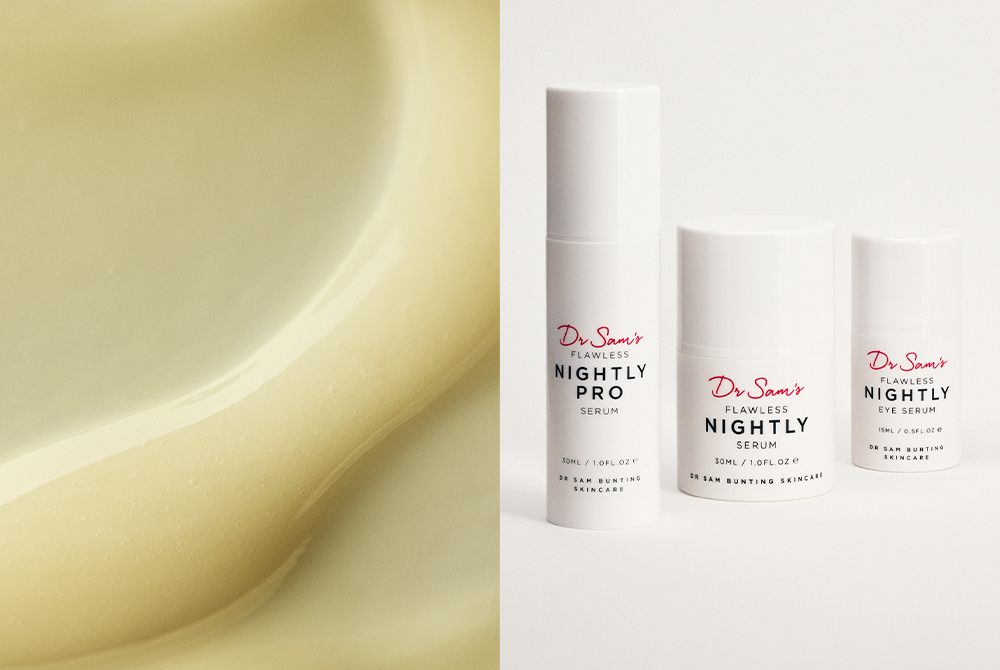
The Flawless Nightly series is built on Granactive Retinoid, which delivers HPR in a form optimised for skin penetration and stability. Granactive Retinoid is a trade name, not a pure active. The blend is 10% HPR and 90% solvent, which means a product labelled 2% Granactive Retinoid contains 0.2% actual HPR — and 5% contains 0.5%. These are meaningful concentrations; HPR is potent at low levels. Flawless Nightly Serum (2% Granactive Retinoid) is the starting point for those new to retinoids or building tolerance. Flawless Nightly Pro (5% Granactive Retinoid) is for skin that has adapted and is ready for a stronger biological response. Both are formulated alongside bakuchiol and other complementary actives at meaningful concentrations to maximise the retinoid effect without unnecessary irritation. Flawless Nightly Eye which contains 2% Granactive Retinoid in a hydrating base that is gentle enough for the delicate eye area but makes a profound difference to fine lines and dark circles.
If you’re weighing up retinaldehyde against HPR for your own routine, the evidence increasingly favours the molecule that doesn’t leave the heavy lifting to your skin.
If you're unsure which retinoid is right for your skin, especially if you have a specific skin concern, it's worth seeking personalised advice - you can book an online consultation.
The biggest mistake I see in acne isn’t the product you’re using - it’s how you’re using it.Most people treat blemishes spot by spot, chasing each new eruption like a never-ending game of whack-a-...
If you’re over 35 and still breaking out, you’re not doing anything “wrong”- but you may be using an approach that no longer matches your skin’s needs.
After two decades in clinic, helping thousan...
I'm seeing an increasing number of patients who come to me completely confused about what is the right retinoid strength for their skin. They are seeing brands create a bazillion different strengt...