





By Dr Mia Steyn, MBChB, MRCP (Derm), Consultant Dermatologist at Dr Sam Bunting + Associates
Dr Mia Steyn is a Consultant Dermatologist at Dr Sam Bunting + Associates. She trained at the University of Stellenbosch and completed her post-graduate specialist dermatology training at the prestigious St John’s Institute of Dermatology in London, where she subsequently held a consultant role managing complex medical dermatology cases. She is on the GMC specialist register. Her clinical focus encompasses the full spectrum of dermatological conditions, from acne and rosacea to pigmentation, eczema, and hair loss, and she brings particular expertise to patients whose skin conditions have proved difficult to diagnose or manage elsewhere.
You’ve had breakouts before, you know what a spot looks like. But lately something feels different. Your face is redder than it used to be, not just around the spots but in between them. Products that once worked are making things worse. And the standard acne advice you’ve tried isn’t shifting it. You’re starting to wonder: is this actually acne? Or is something else going on?
This is one of the most common questions I encounter in the clinic, and the confusion is entirely understandable. Acne and rosacea share enough visual features that they’re easy to conflate even by clinicians who see skin every day. They can both produce red, inflamed bumps on the face, both flare with hormonal shifts, and both make you reluctant to leave the house without coverage. But they are different conditions, driven by different mechanisms, and critically, they respond very differently to treatment. Getting this distinction right is the key to making real progress with your skin.
How Do You Tell the Difference Between Acne and Rosacea?
The single most reliable distinguishing feature is one you can check yourself: comedones. A comedone is a blocked pore : what we call a blackhead (open comedone) or a whitehead (closed comedone). Comedones are the foundation of acne. Without them, a true acne diagnosis becomes much less likely.
Rosacea does not produce comedones. It can produce papules (solid red bumps) and pustules (bumps with a yellowish tip) that look superficially similar to acne spots, but these arise from a completely different process. In rosacea, inflammation is driven by vascular dysregulation and innate immune activation, not a blocked follicle. So if your skin is producing red bumps but you cannot find any blackheads or whiteheads, rosacea should be on your radar.
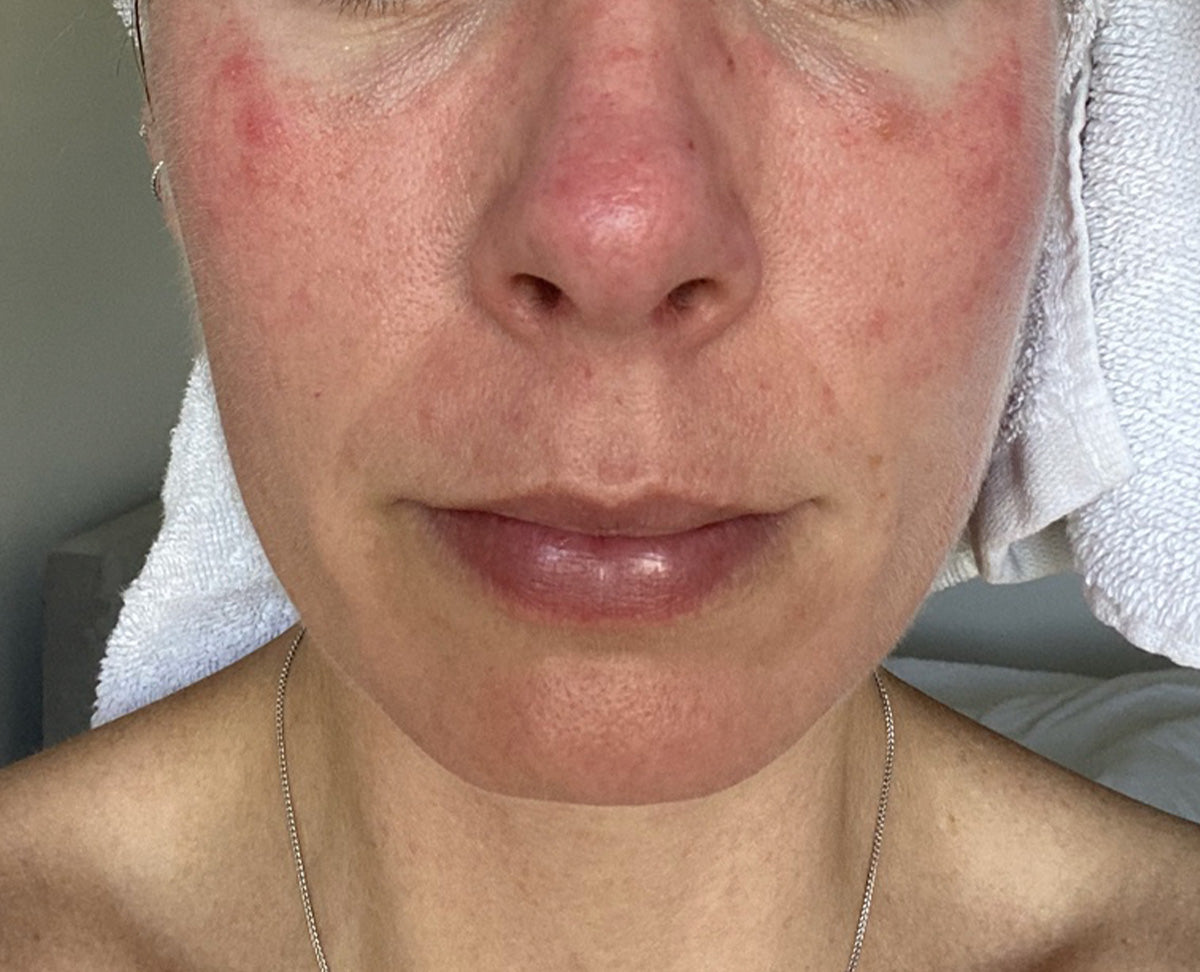
The second distinguishing feature is background redness. Rosacea almost always involves some degree of erythema, with persistent redness across the central face, the cheeks, nose, and chin that persists even when there are no active spots. In acne, redness is typically localised to active lesions, not diffused across the skin between them.
Third: flushing. Rosacea patients frequently experience episodic flushing, a rapid, sometimes burning wave of redness triggered by heat, exercise, alcohol, spicy food, emotional stress, or temperature changes. Acne does not cause flushing. If you recognise this pattern in yourself, it’s another sign your skin may have shifted.
Acne vs Rosacea: Key Differences at a Glance
| Feature | Acne | Rosacea |
| Comedones (blackheads/whiteheads) | Yes - a defining feature | No |
| Persistent background redness | No | Yes - characteristic |
| Flushing episodes | No | Yes - common |
| Typical distribution | Face, chest, back, jawline | Central face predominantly |
| Response to strong exfoliants | Often helpful | Frequently worsening |
For a fuller breakdown of rosacea, including its subtypes and what drives it clinically, read What Is Rosacea? Everything You Need To Know. If acne is your primary concern, The Acne Mistake Almost Everyone Makes and How to Fix Adult Acne Without Drying Out Your Skin are good starting points.
Why Does Misdiagnosis Happen So Often?
The most common point of confusion is papulopustular rosacea, the subtype that produces red bumps with yellowish centres. These look almost identical to the inflammatory acne lesions most people are familiar with, and without training it’s difficult to tell them apart.
The consequences of misdiagnosis are more than frustrating; they’re actively harmful. Strong acne treatments applied to rosacea-prone skin can strip barrier function and trigger significant flares. The most common error I see is patients applying high-concentration salicylic acid, aggressive physical exfoliants, or prescription-strength retinoids to what is actually rosacea, then wondering why their skin is becoming increasingly reactive, red, and inflamed. The treatments aren’t failing because the acne is stubborn. They’re failing because the diagnosis was wrong.
The reverse is also true. Someone with adult acne who starts treating themselves for rosacea, avoiding anything that might cause warmth or redness, refusing retinoids out of fear of irritation and may be significantly under-treating their condition.
Signs You Might Be Treating the Wrong Condition
This tends to resonate most with patients who’ve spent months trying to fix their skin without success. If you’ve used a consistent acne routine for three months or more and your spots haven’t improved, or your skin has become more reactive and red, not less, it’s worth pausing. The same is true if heat, wine, exercise, or stress predictably trigger flushing regardless of what you’re using on your skin. Look carefully for blackheads and whiteheads:
if you can’t find any and your blemishes cluster on the cheeks and nose rather than across the forehead or chin, that’s meaningful. So is skin that feels increasingly sensitive and tight rather than oily, or any history of eye symptoms, grittiness, redness, or light sensitivity, alongside facial redness. There is also a genetic component to rosacea, so a family history is worth noting.
None of these individually confirms rosacea. But in combination, they’re a strong enough signal that continuing to treat on your own, without a proper assessment, carries a real risk of prolonged harm.
Does the Treatment Actually Differ That Much?
Yes, substantially. The approaches overlap in some areas and diverge significantly in others, and that overlap is exactly what makes self-treatment so risky when you’re not certain of your diagnosis.
For our full guide to rosacea treatment, including the five most common mistakes, read 5 Biggest Mistakes When Treating Rosacea. For acne, How to Fix Adult Acne Without Drying Out Your Skin and our guide to using salicylic acid correctly are worth reading before you build your routine. And if you’re navigating both conditions at once, 4 Actives That Treat Both Ageing and Acne covers the ingredients that can work across both without causing harm.
Frequently Asked Questions
Can rosacea be mistaken for acne?
Yes, and it happens frequently even in people who have already seen a GP. Both conditions can produce red, inflamed papules and pustules on the face, and without specialist training it is easy to conflate them. The key distinguishing features are: persistent background redness or flushing in rosacea, the absence of comedones, and the distribution: rosacea clusters on the central face, particularly the nose and cheeks, while acne tends to involve the forehead, chin, and jawline more heavily. If someone has been prescribed an acne treatment that isn’t working, or if it’s making their skin more red and reactive, misdiagnosis is a serious possibility worth investigating properly.
What are the red bumps on my face: acne or rosacea?
The distinction lies in what’s happening underneath the bump, and what’s surrounding it. Acne papules and pustules develop from a blocked follicle, a comedone that has become inflamed. In rosacea, inflammatory papules and pustules arise from vascular and immune-mediated inflammation without a blocked pore at their root. The practical clinical clue: look carefully for comedones. If you can find blackheads or whiteheads alongside the red bumps, acne is far more likely. If the red bumps are sitting on a background of persistent redness or are accompanied by visible thread-like blood vessels (telangiectasia), rosacea moves up the differential considerably.
Can you have acne and rosacea at the same time?
You can, and it’s more common than patients expect. I see this regularly, typically in women in their 30s and 40s who had teenage acne, managed it, and then notice a new pattern of redness and flushing emerging alongside residual blemishes. When the two conditions coexist, treatment needs to be carefully sequenced, because certain retinoids at higher concentrations and aggressive chemical exfoliants like glycolic acid can be significantly destabilising for rosacea-prone skin. This overlap is one of the strongest reasons to seek a formal diagnosis rather than treating by trial and error.
Does acne cause skin redness and flushing?
Acne can produce redness localised to an active spot or a cluster of lesions, but it does not cause generalised facial flushing or persistent background redness in the way rosacea does. Flushing, the rapid onset of widespread facial warmth and redness triggered by heat, alcohol, spicy food, or emotional stress, is a hallmark feature of rosacea, and I would not expect to see it in straightforward acne. If you are experiencing flushing episodes alongside blemishing, that combination should prompt a proper dermatological assessment rather than continued self-treatment.
When to See a Dermatologist
If you’ve been treating your skin for months without the clarity or the results you deserve, it may simply be that you’re working from an incomplete picture. Knowing whether you’re dealing with acne, rosacea, or a combination of both is the single most important piece of information your skin routine can be built around. Without it, even the best products are guesswork.
At Dr Sam Bunting + Associates, our team of consultant dermatologists sees this exact pattern of confusion every week. A consultation gives you a clinical diagnosis, a treatment plan built around your specific presentation, and the confidence to stop second-guessing your skin. To book, visit our Book an Appointment page